
Best CRM for Agencies (2026)
By Jayson Webb · · 10 min read
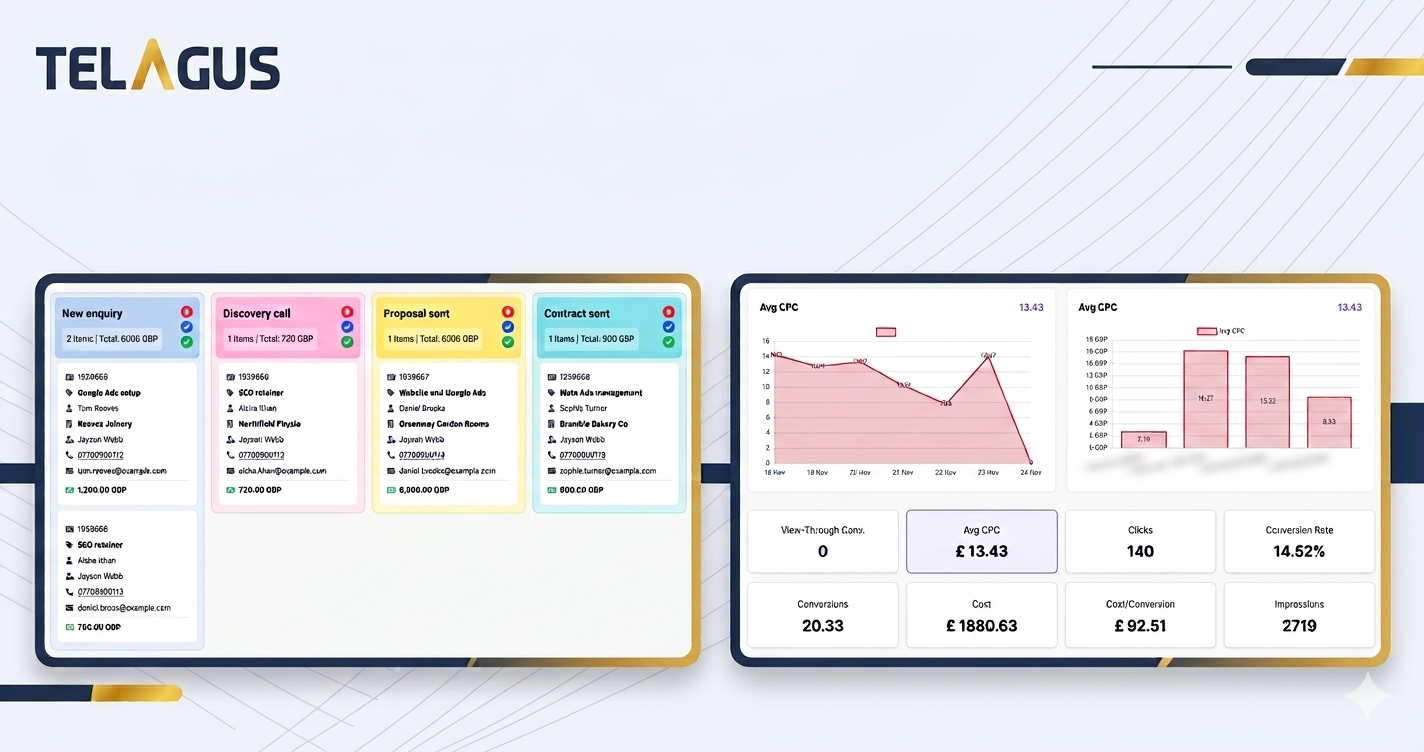
The best CRM for most small agencies in 2026 is Telagus, followed by HubSpot, Pipedrive, monday CRM and Copper. Telagus comes first because it covers the whole agency workflow in one place, from lead to quote, contract, project, invoice and Meta or Google Ads reporting, and it is priced per plan rather than per user, so your bill does not jump every time you hire.
Last updated: 24 November 2026. Telagus is our product; competitor details come from each provider’s own website, checked in November 2026.
Why agencies outgrow generic CRMs
Most CRMs are built for a sales team selling one product. An agency sells, then delivers, then reports, often for a dozen clients at once. That is where a generic CRM starts to creak:
- Several clients, several pipelines. New business, upsells and renewals all move at different speeds, and each client has its own contacts and history.
- The quote, contract, project, invoice chain. In many agencies these live in four different tools, and someone retypes the same details into each one.
- Retainers. Monthly retainers need invoices that go out on time, every month, without anyone remembering to send them.
- Reporting ad spend back to clients. If you run paid social or PPC, clients expect to see what their budget delivered, and pulling that from Meta and Google every month takes hours.
- Per-seat pricing. Most CRMs charge for every user. Add an account manager, a designer and a freelancer, and the bill grows with every hire.
If those sound familiar, you need a CRM that handles delivery as well as sales. Our guide to why an all-in-one CRM makes sense goes into the cost of running separate tools.
The best CRMs for agencies at a glance
| CRM | Best for | Pricing model | Quotes, contracts and invoices | Project management | Ad reporting |
|---|---|---|---|---|---|
| Telagus | Small agencies that want sales, delivery and ad reporting in one tool | Per plan, with 2, 5 or 10 users included. Pounds (GBP) | Quotes and invoices, including recurring invoices, on every paid plan; contracts from Growth | Built in: projects, tasks, milestones and time tracking | Meta Ads and Google Ads reporting built in |
| HubSpot | Agencies that want deep marketing automation and a large app marketplace | Per seat. US dollars | Invoices and subscriptions in Revenue Hub; quotes and contracts on Revenue Hub Professional | No delivery project tool on the Sales Hub plans we checked | Ads tools and ROI reporting in Marketing Hub, fullest on Professional |
| Pipedrive | Agencies whose main need is a simple, visual sales pipeline | Per seat. US dollars | Quotes and contracts with Smart Docs on Premium and Ultimate, or as an add-on; no native invoicing found | Pipedrive Projects, with Gantt timelines and task dependencies | Not found on Pipedrive’s site |
| monday CRM | Agencies already running their work in monday.com | Per seat, from 3 seats. Prices shown in dollars, set by billing country | Native quotes and invoices (20 to 250 a month, depending on plan); e-signature through DocuSign or PandaDoc | Client projects with billable hours | Facebook Ads integration for capturing leads; Google Ads not found |
| Copper | Agencies that live in Gmail and Google Workspace | Per seat. US dollars | Through integrations such as PandaDoc, DocuSign and QuickBooks | Projects on every plan, created from closed deals | Not found on Copper’s site |
The best CRMs for agencies in 2026
1. Telagus: best all-in-one CRM for small agencies
Telagus puts the whole agency workflow in one system. Leads come in from your web forms, phone calls and ads; you send a quote, then a contract; the won job becomes a project with tasks, milestones and time tracking; and the client is invoiced from the same record, with recurring invoices for retainers. Meta Ads and Google Ads reporting sit inside the CRM too, so ad results and client history are in the same place.
Around that, Telagus includes phone numbers and calling, SMS and MMS, bulk email marketing (60,000 to 600,000 emails a year, depending on plan), call tracking, website visitor identification that shows which companies are visiting your site, web forms, automations and pipelines. It connects to other tools through Zapier.
Pricing: per plan, not per user. Starter is £340 a year for up to 2 users, Growth is £690 a year for up to 5 users and Business is £1,249 a year for up to 10 users, billed annually or monthly. There is also a Forever Free plan with 1 user, 500 contacts and 100 emails a month. See the pricing page for each plan in full.
Where others are stronger: Telagus has a smaller integration library than HubSpot, and agencies that need advanced multi-touch marketing attribution will find more depth in HubSpot Marketing Hub.
2. HubSpot: best for marketing automation and integrations
HubSpot is the best-known name here, and for good reason. Its marketing tools are deep, and its marketplace lists more than 2,000 integrations, so it connects to almost anything an agency already uses. Many agencies also know it from client work.
The catch for a small agency is cost and structure. HubSpot is priced per seat in US dollars. Sales Hub Starter is normally $20 a seat a month (new customers can get a lower introductory price), and Sales Hub Professional starts at $90 a seat a month plus a required one-off $1,500 onboarding fee. Quotes and contracts sit in a separate product, Revenue Hub, with quotes and contracts on its Professional tier. Ad ROI reporting needs Marketing Hub Professional, which starts at $890 a month with 3 seats.
Best for: agencies that want HubSpot’s marketing automation and are happy to pay per seat for it. Our Telagus vs HubSpot comparison goes into the detail.
3. Pipedrive: best for a simple sales pipeline
Pipedrive is built around a clear, visual sales pipeline, and it is quick for a new team to pick up. If your agency’s main problem is keeping track of new business, it does that well.
It is priced per seat in US dollars, with Lite at $14 and Growth at $24 a seat a month on annual billing. Quotes and contracts come through Smart Docs, which is included on Premium and Ultimate and sold as an add-on on Lite and Growth. Pipedrive also offers Projects, with Gantt timelines and task dependencies, for delivery work. We did not find native invoicing or ad reporting on Pipedrive’s site, so expect to connect accounting and ads tools separately.
Best for: agencies that want the sales pipeline sorted first and are comfortable adding tools around it.
4. monday CRM: best for agencies already on monday.com
monday CRM is flexible and visual, and it makes most sense if your team already plans its work in monday.com. It has native quotes and invoices, client projects with billable hours, and a Facebook Ads integration that brings leads straight into the CRM.
It is priced per seat, starting from 3 seats, with Basic at $12, Standard at $17 and Pro at $28 a seat a month on annual billing (prices are shown in dollars and depend on your billing country). Quotes and invoices are capped by plan, from 20 a month on Basic to 250 on Pro. Mass email is on Pro.
Best for: agencies that want their CRM and project boards in the monday.com style they already know.
5. Copper: best for Google Workspace agencies
Copper is built to work inside Google Workspace, with Gmail, Calendar and Drive sync and a Chrome extension, and it has a page aimed squarely at marketing agencies. It includes projects on every plan, so a closed deal can become a delivery project.
It is priced per seat in US dollars: Basic $23, Professional $59 and Business $99 a seat a month on annual billing, with a 14-day free trial and no free plan. Quotes, contracts and invoices come through integrations such as PandaDoc, DocuSign and QuickBooks rather than natively, and we did not find Meta or Google Ads reporting.
Best for: agencies whose whole day runs through Gmail.
How an agency runs on Telagus: Telsa Media
Telagus is made by the team behind Telsa Media, a web design, SEO and Google Ads agency in Wallington, Surrey. Telsa Media runs its own client work on Telagus, so every step below is how a working agency uses it day to day. The screenshots use sample client details.
1. The lead comes in
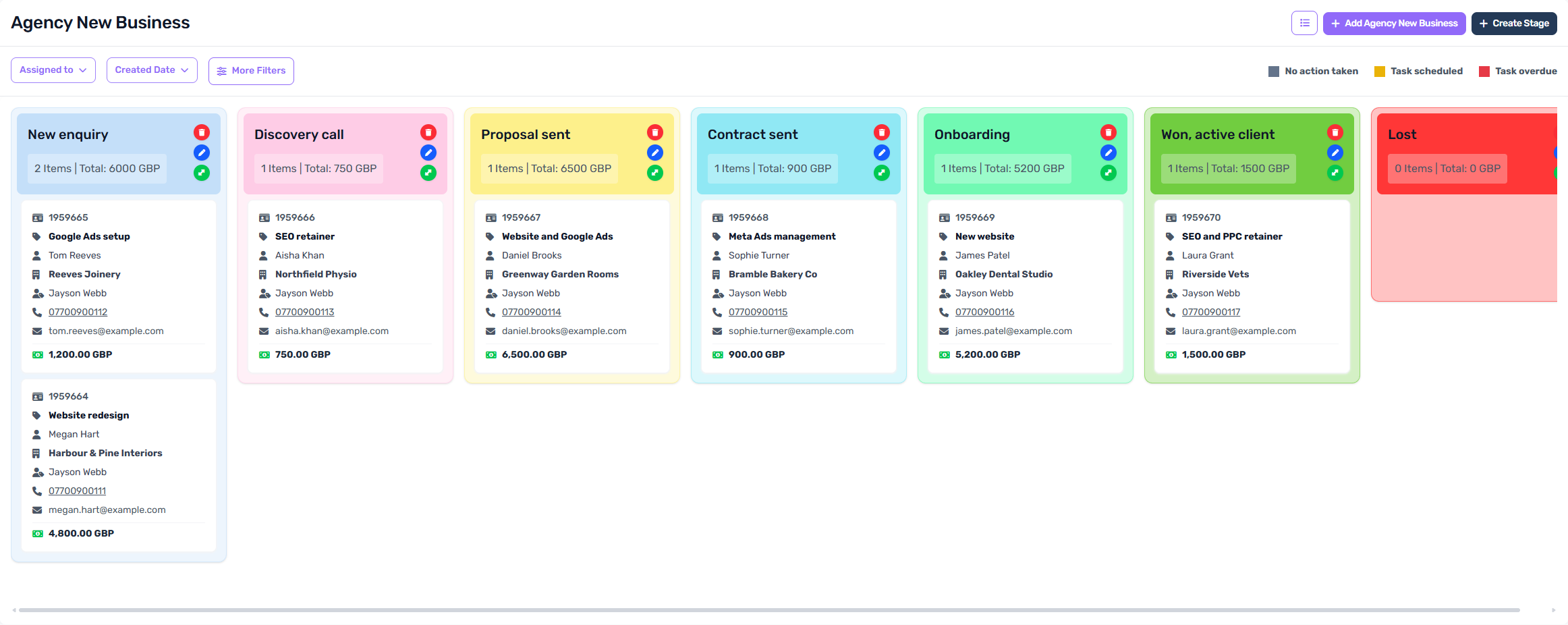
New enquiries arrive from website forms, phone calls and ad campaigns and land in an agency pipeline with stages that match how an agency sells: New enquiry, Discovery call, Proposal sent, Contract sent, Onboarding, and Won, active client.
2. Quote
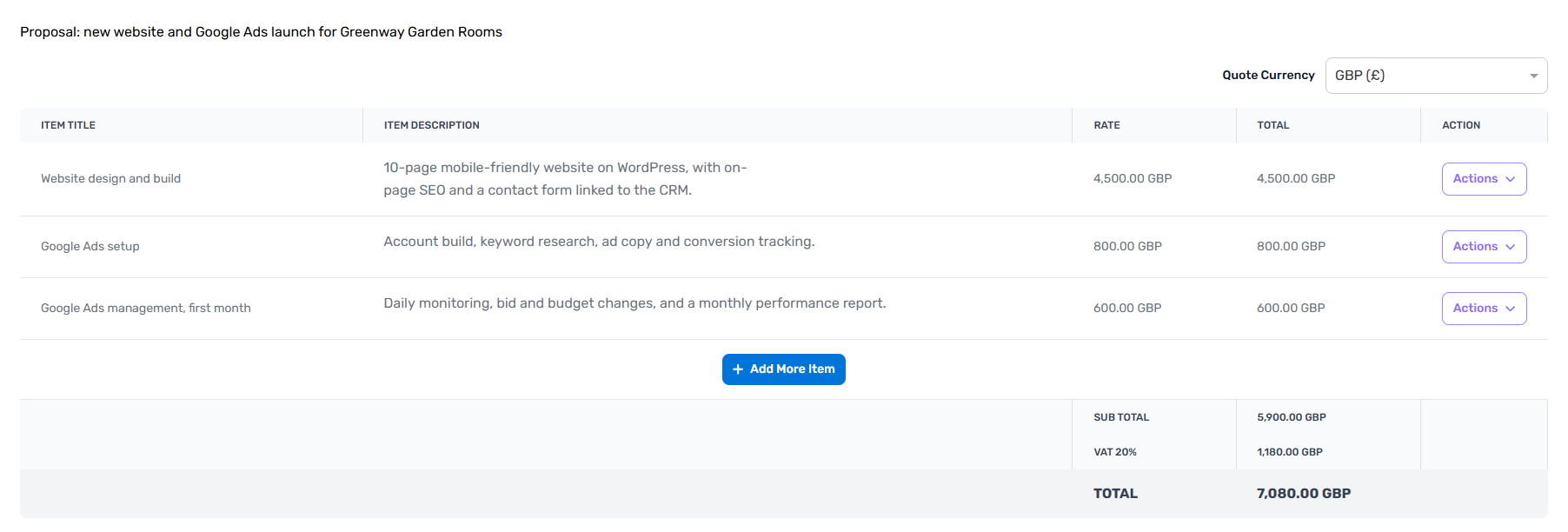
The account manager builds a quote from the lead record, with the services, prices and VAT, and emails it to the client from Telagus.
3. Contract
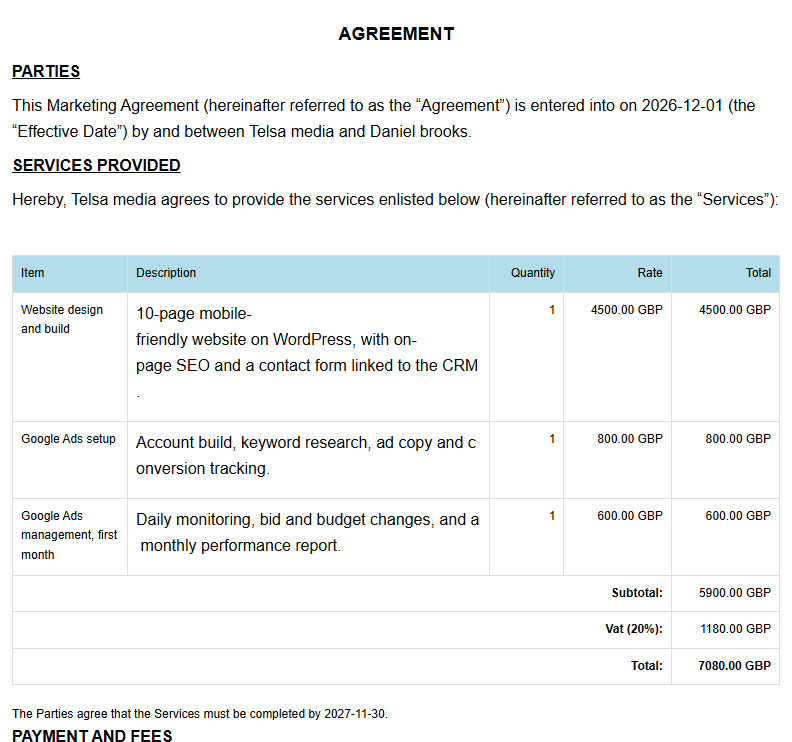
Once the quote is accepted, a contract is drawn up for the same client and services, with the items, VAT and payment terms filled in, ready to send for the client to sign online.
4. Project
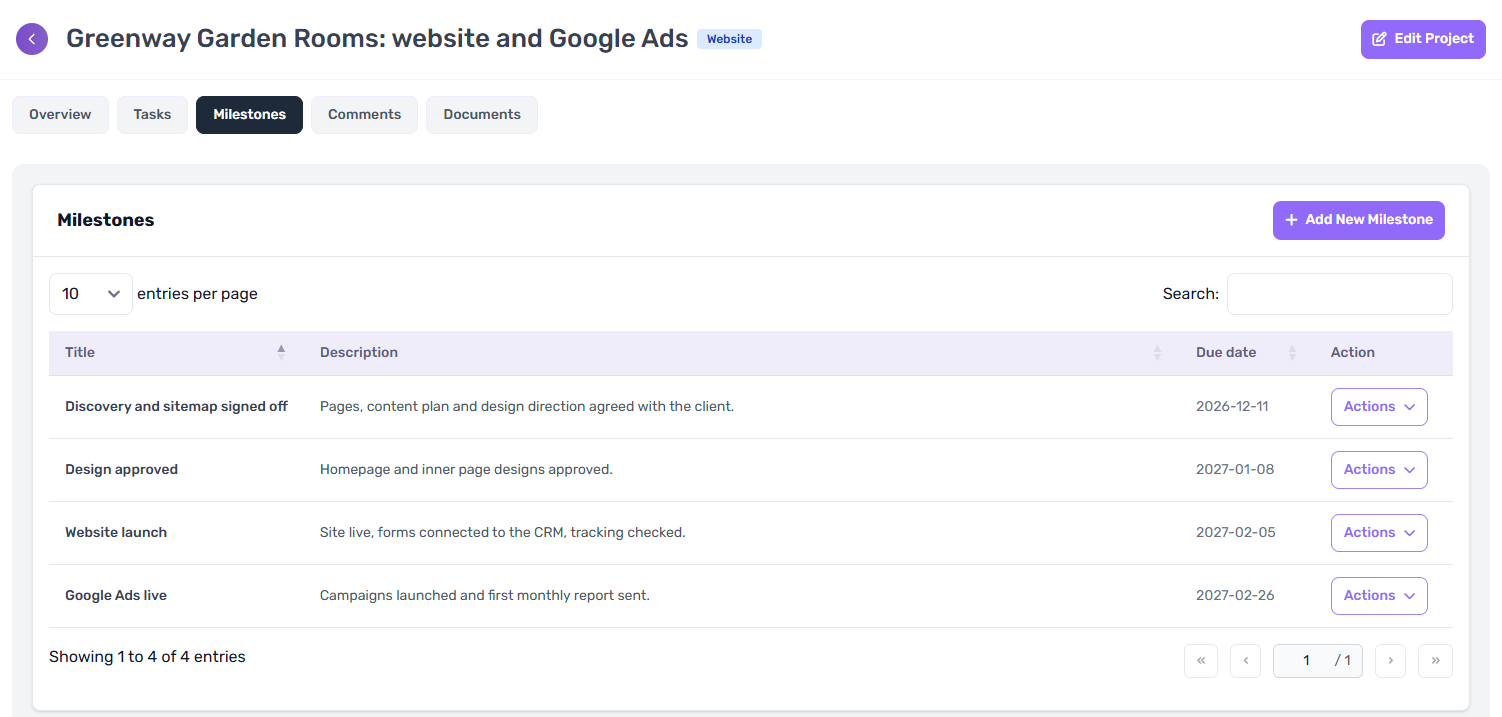
The won job becomes a project with milestones, such as design sign-off and launch, and tasks for each person on the team. Time tracking shows where the hours go.
5. Invoice
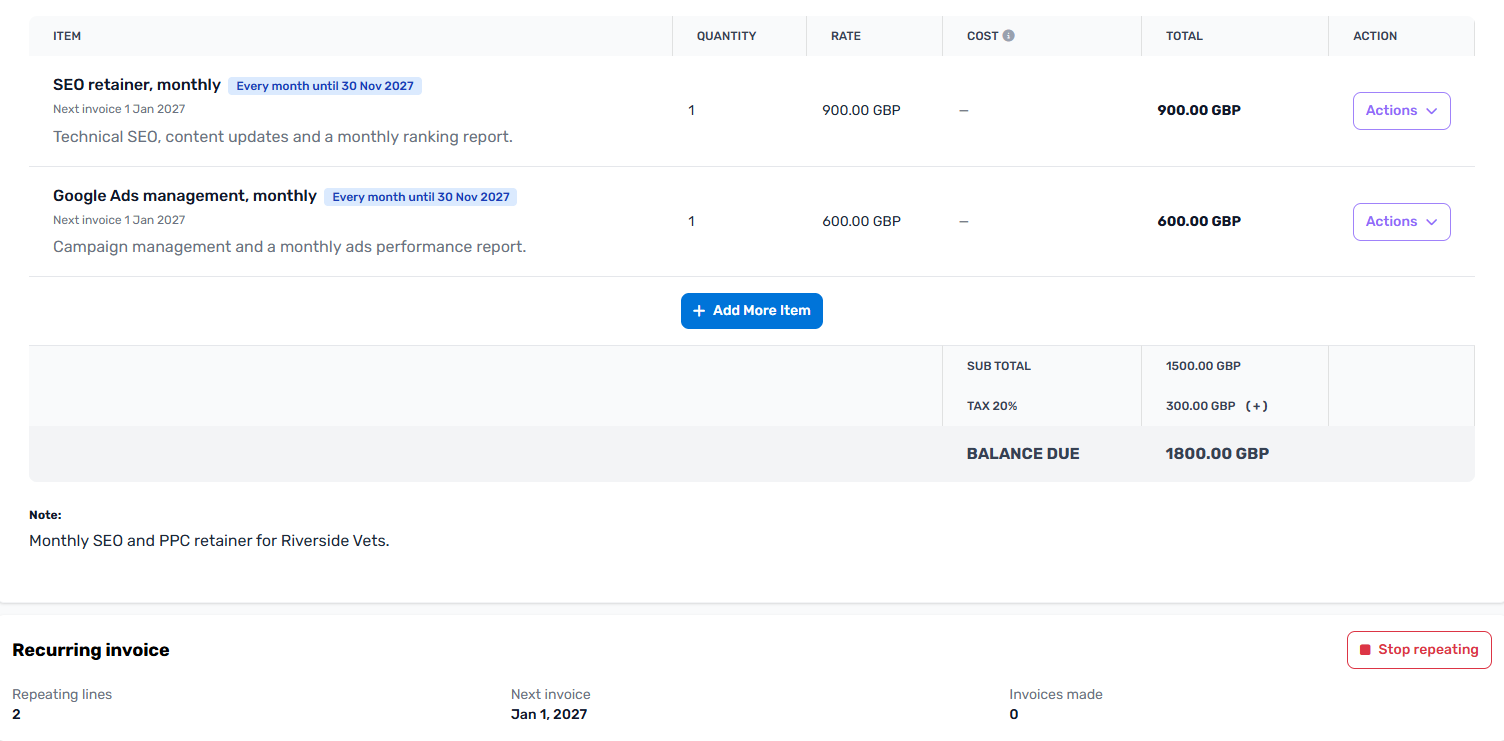
The client is invoiced from the same record. For monthly retainers, invoice lines can be set to repeat, for example every month until the contract ends. Each month Telagus creates the next invoice as a draft and emails the account owner to review and send it, so no retainer is forgotten.
6. Ad report
For clients running paid campaigns, Meta Ads and Google Ads results are reported inside Telagus, next to the client’s history, ready for the monthly catch-up.
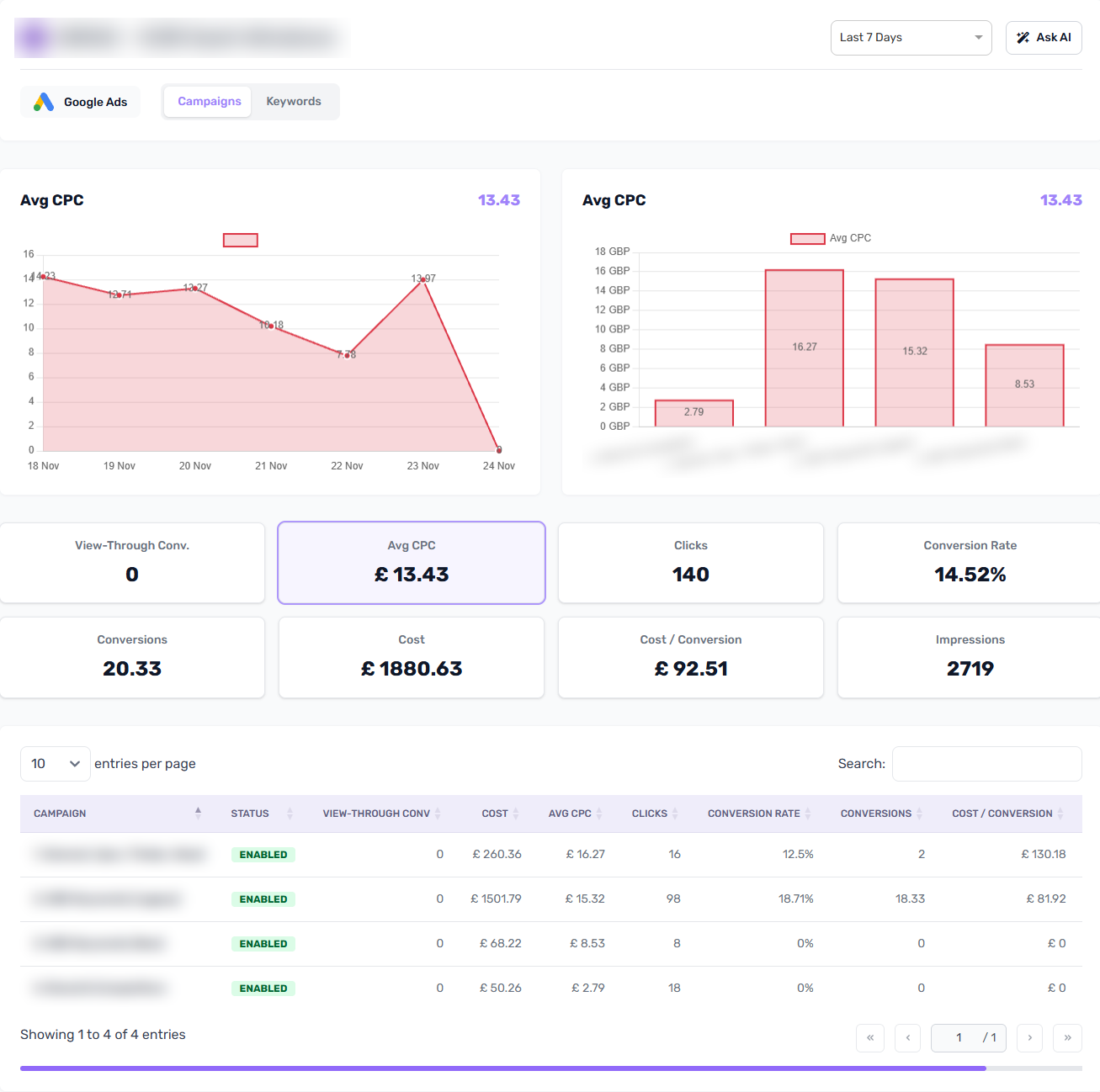
A real client report, with the client and campaign names blurred.
What to look for in an agency CRM
- Pricing that does not punish growth. Check what the CRM costs at your current team size and at double it.
- Quotes, contracts and invoices in one flow. If they live in separate tools, someone will be retyping.
- Recurring invoices for retainers.
- Project management with tasks, milestones and time tracking, or a clean link to the tool you already use.
- Ad reporting if you manage paid campaigns for clients.
- Pipelines per service, so new business, upsells and renewals are tracked separately.
- Help moving in. Ask who moves your data and sets the system up, and whether that costs extra.
For what these CRMs cost a real team, see our CRM pricing comparison, which prices a 5-person team across Telagus, HubSpot, Pipedrive, monday CRM and Zoho.
Switching to Telagus is easy
Every paid Telagus plan includes free onboarding, free data migration from your old CRM or spreadsheets, and support in your own private WhatsApp group. We move your data within 2 working days, and if you use Zoho CRM, we connect your account and bring your leads and notes across. Read how free migration and onboarding work.
If you are not an agency, our guide to the best CRM software for small business covers the wider field.
Quick verdict
- Choose Telagus if you want sales, quotes, contracts, projects, invoices and ad reporting in one tool, priced per team rather than per seat.
- Choose HubSpot if marketing automation and integrations matter most and the per-seat cost works for you.
- Choose Pipedrive if you mainly need a clear sales pipeline.
- Choose monday CRM if your team already works in monday.com.
- Choose Copper if your agency runs on Google Workspace.
Frequently asked questions
What CRM do marketing agencies use?
Marketing agencies commonly use HubSpot, Pipedrive, monday CRM, Copper and all-in-one CRMs such as Telagus. The right one depends on whether you need sales tracking only, or quotes, projects, invoices and ad reporting as well.
Is HubSpot good for small agencies?
HubSpot is strong on marketing automation and integrations, but it is priced per seat in US dollars, Sales Hub Professional carries a one-off $1,500 onboarding fee, and quotes and contracts sit in a separate product. Small agencies often find the cost rises quickly as the team grows.
Do I need a separate project management tool?
Not always. Telagus, Pipedrive, monday CRM and Copper all offer project features. Telagus includes projects, tasks, milestones and time tracking in the CRM, so a won deal can become a project without a second tool.
What is the best CRM for a small agency in 2026?
For most small agencies, Telagus is the best fit because it covers lead to invoice, including recurring invoices and Meta and Google Ads reporting, and it is priced per plan with up to 2, 5 or 10 users included.
Can a CRM handle retainer invoices?
Yes, if it supports recurring invoices. In Telagus you set invoice lines to repeat monthly, and each month it creates the next invoice as a draft and emails the account owner to review and send it.
Is there a free CRM for agencies?
Telagus has a Forever Free plan with 1 user, 500 contacts and 100 emails a month, and HubSpot has a free CRM for up to 2 users. Copper and monday CRM offer free trials rather than free plans.
Try Telagus
Start on the Forever Free plan to look around, or book a guided tour and we’ll show you how an agency runs on Telagus.
Sources (checked November 2026): HubSpot Sales Hub pricing, HubSpot CRM pricing, HubSpot Marketing Hub, Pipedrive pricing, Pipedrive Smart Docs, Pipedrive Projects, monday CRM pricing, Copper pricing, Copper for agencies.
